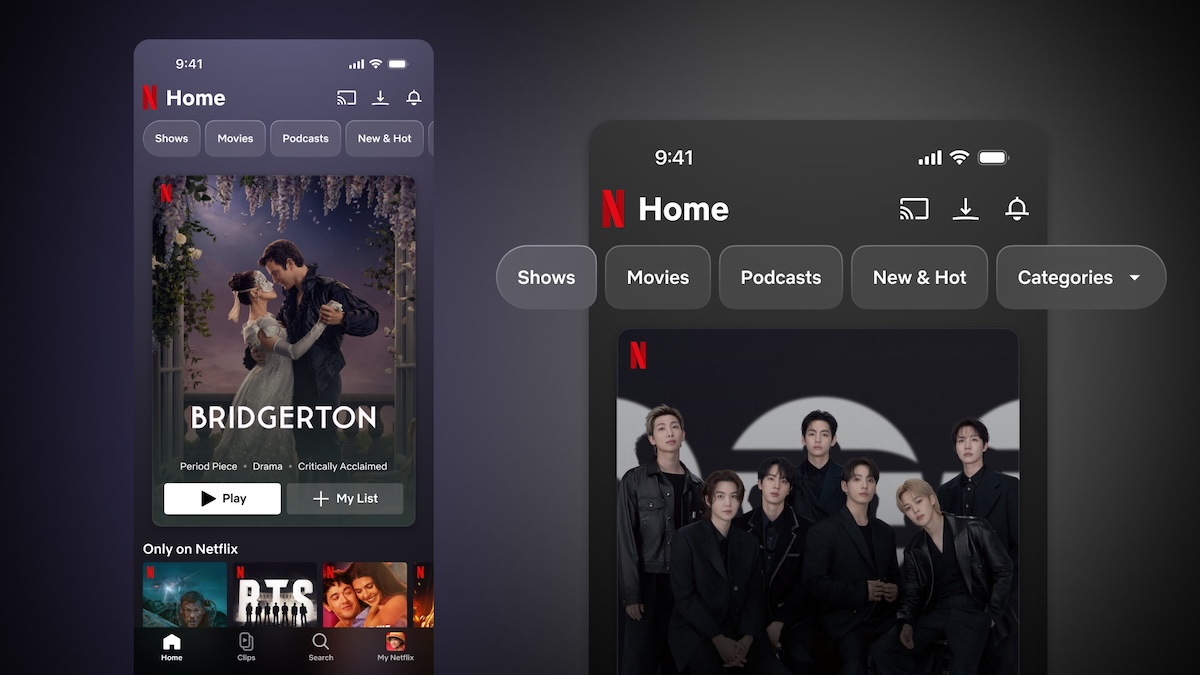
Streaming giant Netflix announced plans during its recent APAC Product Innovation Showcase to expand its redesigned mobile application and scale its children’s gaming initiative across the Asia-Pacific region this July, aiming to deepen subscriber engagement through vertical video and interactive content.
Rolling Out the Revamped Mobile Interface in Key Asian Markets
As official details revealed during the showcase indicate, Netflix is actively broadening the global footprint of its updated mobile app. Following initial launches in Australia, New Zealand, the Philippines, India, and Malaysia earlier this year, the company plans to officially deploy the new experience in South Korea and Japan in July, with further Asia-Pacific markets scheduled to follow shortly after.
Curated “Clips” and Short-Form Video Content
A central component of this redesign is “Clips,” a vertical video feed created to address the growing consumer demand for short-form media. The feature allows mobile users to swipe through bite-sized previews from across the platform’s streaming catalog, delivering rapid entertainment for audiences without time for a full episode or feature film.
To enhance discovery, Netflix is evolving this concept by testing curated, themed Clip collections. These curated feeds group short clips according to specific moods, genres, and audience interests, encompassing memorable reality television moments, exclusive behind-the-scenes footage, and highlights from popular podcasts.
Image Credits:Netflix
Doubling Down on Children’s Gaming via Netflix Playground
Parallel to its core video streaming updates, Netflix is committing further resources to interactive software. The company confirmed an expansion of Netflix Playground, its specialized gaming hub tailored specifically for children’s entertainment.
Leveraging “KPop Demon Hunters” for Interactive Growth
The latest iteration of Netflix Playground will centered around “KPop Demon Hunters,” the hit animated musical that rapidly established itself as one of the platform’s leading family titles. The new experience introduces six dedicated mini-games, giving young viewers the opportunity to interact directly with story lines and characters from the film.
This strategic integration follows massive viewership numbers for the IP, which accumulated over 518 million views during its initial six months on the service. By converting popular intellectual property into interactive games, Netflix seeks to drive engagement and retain family subscribers within its digital ecosystem.
Netflix Playground was initially debuted in April across key markets, including the United States, Canada, and the United Kingdom, establishing a blueprint for its ongoing international rollout.
Meta is officially spinning off its popular VR fitness platform Supernatural into an independent entity called Supernatural Health, restoring active development to the app following widespread user protests over frozen content updates.
From a $400 Million Acquisition to VR Abandonment
In 2023, Meta endured an eight-month antitrust battle against the Federal Trade Commission to acquire Within, the development studio behind Supernatural, in a deal valued at approximately $400 million. Despite the massive financial investment and legal hurdle to acquire the virtual reality workout title, Meta significantly downsized its VR division just a few years later and halted all new content development for the application.
The Launch of Supernatural Health
Following roughly five months of backlash from dedicated users who protested the platform’s stagnant state, Meta granted the development team permission to transition into a new independent company. The newly formed entity, Supernatural Health, is spearheaded by the app’s original founders and will fully assume control of operations later this year.
What the Transition Means for Active Subscribers
According to an update published on the app’s official website, the core experience of the platform will remain intact during the restructuring process.
“Supernatural is being reborn. Same coaches, same DNA, same obsession with making fitness feel like the best part of your day — now under a new, independent company we’re starting from the ground up,” stated Supernatural Health.
Addressing the corporate separation, the company explained: “We’re grateful for the platform and resources Meta provided during a critical growth phase. This transition reflects a shared belief that Supernatural’s community is best served by a focused, independent team. Meta has been supportive throughout.”
Community Reactions to Big Tech Independence
The decision to spin off the platform marks an unusual reversal in big tech acquisitions, where underperforming or sidelined software is typically shuttered completely rather than returned to its creators.
The news brought immediate relief to the app’s user base, many of whom feared the service was destined for permanent shutdown. “Like so many of us I was so devastated when the coaches were let go and we were told our beloved Supernatural, while we loved it and it was great, would never get any better than it was. What we had was what we had. We all felt like it was purchased to kill,” one subscriber shared in the public Supernatural Facebook group.
Brynn Putnam, the entrepreneur behind connected-fitness pioneer Mirror, has secured $20 million in new funding for her physical-digital gaming startup, Board, as the platform expands into tens of thousands of locations across all 50 U.S. states.
A $399 Interactive Display Merging Physical and Digital Play
Board centers on a $399 hardware device featuring a 24-inch touchscreen encased in a wood-finish frame. Utilizing proprietary object-recognition technology, the system detects physical game pieces placed on its screen, combining the tactile satisfaction of traditional tabletop games with the dynamic capabilities of digital software.
Commercial momentum has accelerated rapidly since the product’s market entry. Board’s units are now deployed in tens of thousands of households, educational institutions, healthcare facilities, and dining establishments nationwide. Engagement metrics indicate high retention, with 85% of active customers recording 30 or more gaming sessions per month.
AI-Powered Game Creation via Board Studio
To expand its software ecosystem, the company announced Board Studio alongside its capital raise. Scheduled to launch later this year, the AI-driven development suite allows creators to generate custom tabletop games using simple natural language prompts, turning initial concepts into functional, playable prototypes in less than an hour.
Venture Capital Alignment and Strategic Pivot
The latest funding round follows a previous $15 million investment led by venture capital firm Lerer Hippeau. The firm originally backed Putnam by leading a $3 million seed round for Mirror, an investment that yielded significant returns when Lululemon acquired the fitness hardware brand in 2020.
For Putnam, Board represents an evolution in consumer hardware design philosophy. Reflecting on her transition from fitness tech, Putnam previously noted that Mirror focused heavily on individual performance, personal metrics, and self-improvement. In contrast, her current venture focuses on shared social experiences, aiming to leverage screen technology to encourage face-to-face interpersonal connection rather than isolated digital consumption.
Consumer Hardware Recovery Driven by AI Innovations
The capital infusion reflects a broader shift in the venture capital environment, where investor interest in consumer hardware is rebounding due to practical applications of artificial intelligence. Ben Lerer, managing partner at Lerer Hippeau, highlighted this market shift, noting that advancements in foundational AI models are enabling hardware capabilities that were technically unfeasible just a year ago, spurring a new wave of high-caliber founders entering the sector.
Data breach notification platform Have I Been Pwned revealed that popular Grand Theft Auto V cheat provider Atlas Menu was recently hacked in a revenge cyberattack against a scammer, exposing personal records from nearly 64,000 user accounts online.
Exposed Data and Unfulfilled Security Claims
The stolen database contains a wide range of sensitive customer information, including email addresses, usernames, scrambled passwords, IP addresses, and customer support tickets. This leak exposes tens of thousands of players to severe privacy risks and potential account takeovers across other online platforms.
Ironically, Atlas Menu explicitly promised users “secure authentication and enhanced privacy through our advanced encryption techniques” on its official website. Following the incident, the service’s website has gone offline, and the platform’s owners could not be reached for comment.
Revenge Hack Published on GitHub
The hacker responsible for the intrusion publicly posted the stolen customer records onto GitHub. According to statements accompanying the release, the hacker’s primary motivation was exacted revenge against an alleged scammer associated with the service.
In-Game Capabilities and the Multimillion-Dollar Market
Product showcase videos previously available on the site demonstrated that Atlas Menu equipped Grand Theft Auto V players with powerful illegal modifications. These capabilities included character invisibility, a “super jump” function to leap over obstacles, and the ability to fly freely across the game map.
This security incident directly unmasks individuals who paid for illicit software to gain an unfair edge in multiplayer sessions. Modding and game cheating have expanded into a multimillion-dollar commercial industry, fueled by players seeking artificial advantages over legitimate competitors.
A Growing Risk for Cheat Software Users
The breach highlights an escalating trend of malicious software providers becoming high-value targets themselves. Atlas Menu is not the first cheat service to suffer a major database compromise; a dominant private cheat platform for Counter-Strike: Global Offensive was reportedly breached in a similar manner, exposing its entire customer list.
Status AI secured $17 million in combined seed and Series A funding on Tuesday to replace passive social media feeds with interactive, AI-powered role-playing environments. The capital injection targets a growing shift among younger internet users who favor active, immersive storytelling over traditional scrolling platforms.
Reimagining Social Media Through Generative AI
The platform originated from the vision of founder Fai Nur, a self-described “chronically online teenager” who spent years obsessing over pop culture, music groups, and television series online. Following the public release of ChatGPT in late 2022, Nur recognized an immediate opportunity to transform fan engagement through generative software. Rather than merely discussing fictional universes online, users could now actively participate inside them at scale.
To execute this concept, Nur partnered with co-founders Amit Bhatnagar, who brought a background in developing Minecraft games, and Pritesh Kadiwala. Together, the trio built Status AI, a gamified social application designed to let users play any character in any universe. The startup officially emerged from stealth mode last year.
How the Role-Playing Platform Works
Upon entering the app, users establish a custom persona before being placed into a personalized social environment. The mechanics allow participants to step into existing books or television shows, simulate high-profile public lives like running for president, or experience viral internet fame within the app’s ecosystem.
Every environment within Status is user-generated, relying on dynamic player interactions to evolve narrative storylines, settings, and digital figures. Users select a single character as an initial follower and accumulate additional followers as their story advances. The platform offers both single-player and multiplayer modes, attracting interest from entertainment studios and streaming services seeking to build dedicated audiences prior to theatrical or stadium releases.
The Shift From Passive Feeds to Immersive Worlds
The platform’s business model relies on the premise that traditional passive social media—where users merely view content produced by others—is losing traction. Furthermore, early conversational AI models focused strictly on basic text chatbots, such as Character.AI and Chai, are rapidly maturing into broader interactive platforms.
Status aims to establish a new category of consumer software engineered specifically for dynamic, brand-safe, and interactive entertainment rather than simple content distribution.
Industry Heavyweights Back the Immersive Ecosystem
The $17 million funding round drew backing from prominent venture capital firms, including Abstract, General Catalyst, Union Square Ventures, Y Combinator, and LightShed Partners. Strategic investors point to media companies actively searching for new mechanisms to keep audiences engaged inside proprietary intellectual property.
According to consumer investors in the space, next-generation social networks will likely diverge from legacy feed structures. Instead, emerging platforms are expected to operate as multiplayer environments combining digital utility, creative expression, and community building inside unified spaces.
Rapid Metric Growth and Future Expansion
Status plans to use the newly acquired capital to expand its technical infrastructure and handle scaling demands. Platform metrics indicate rapid early adoption, with users creating over 13 million distinct worlds and establishing more than 5 million character profiles.
Demographic data reveals that young female users constitute the primary baseline of early adopters—a demographic historically responsible for driving mainstream cultural adoption across major social platforms.
Origin Lab secured $8 million in fresh funding to help video game developers monetize their proprietary spatial data by selling interactive 3D assets to artificial intelligence companies building spatial world models.
Solving the Data Bottleneck for Major AI Labs
As artificial intelligence labs race to train next-generation spatial and physics-aware models, raw 3D data has quickly become the primary operational constraint. Origin Lab aims to bridge the gap between game studios—sitting on vast, unused 3D simulation data—and heavily funded AI developers seeking structured environments for model training.
“We’ve seen how sharp the revenue scaling can be for data vendors that are serving the major labs,” Fatemi told TechCrunch. “These are very well-capitalized businesses, and the bottleneck for all of them is data.”
Unlocking New Revenue Streams for Game Developers
By transforming in-game environments and telemetry into ML-ready datasets, Origin Lab creates a high-margin monetization pipeline for game creators without compromising their core intellectual property. This infrastructure allows developers to capitalize on the soaring demand for real-world physics and 3D spatial intelligence required by advanced AI world-model builders.
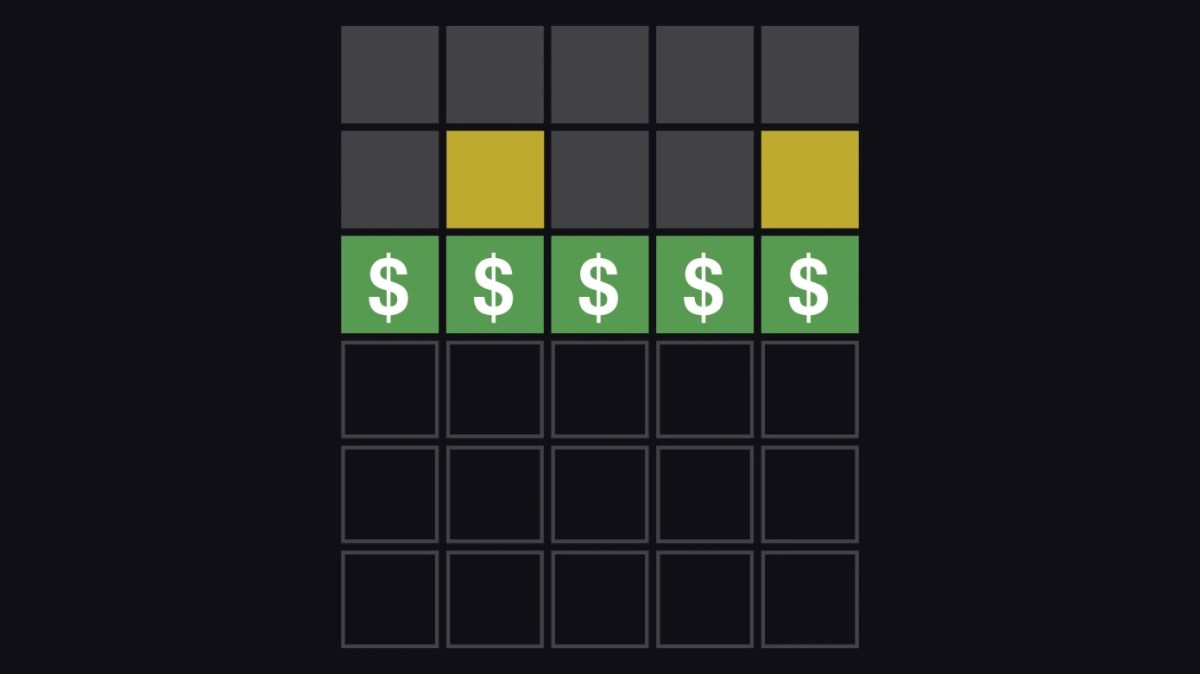
The New York Times announced Monday that its viral daily digital puzzle, Wordle, is transitioning to broadcast television as a new game show on NBC.
Star-Studded Production and Network Debut
“Today” show anchor Savannah Guthrie will host the upcoming series, with production spearheaded jointly by The New York Times and “The Tonight Show” host Jimmy Fallon. Guthrie and Fallon revealed the partnership during the 8:00 a.m. broadcast of the “Today” show on Monday, disclosing that the televised adaptation has been in active development for two and a half years.
A Fast-Paced Format for Broadcast TV
Set to air on NBC next year, the project is framed as a “fast-paced” broadcast designed as a “great family game.” This dynamic setup marks a departure from the mobile game’s signature style, which encourages deliberate, solitary deliberation as players work through letter combinations.
Driving Digital Growth Beyond Print
The deal marks the first time The New York Times has partnered with a major television network for an entertainment program. The venture forms part of the publisher’s broader strategy to expand its digital subscription pipeline and offset long-term declines in print revenue.
Wordle’s Rapid Evolution Into a Gaming Powerhouse
Brooklyn software engineer Josh Wardle originally launched Wordle in October 2021 as a web-based word puzzle. The New York Times acquired the title in January 2022, instantly funneling tens of millions of new users to its digital games portfolio.
The platform’s growth has accelerated significantly since the acquisition. Players completed more than 11 billion puzzles across all NYT Games last year, up from 8 billion puzzles logged in 2023.
Casting Underway for Summer Production
NBC will begin filming episodes of the game show this summer. The network has officially opened applications and is seeking prospective contestants to join the inaugural season.
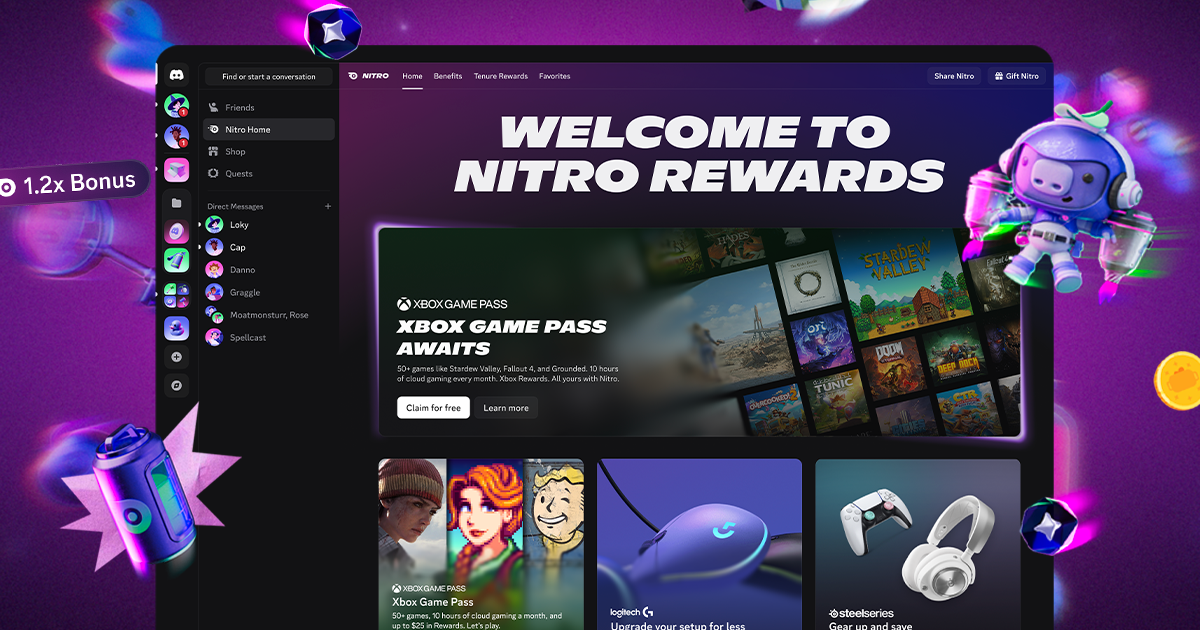
Discord launched Nitro Rewards on Monday, giving $9.99 monthly Nitro subscribers free access to Xbox Game Pass and hardware discounts to drive user retention without paywalling core platform features.
Exclusive Perks: What Nitro Rewards Offers Subscribers
While basic access to Discord remains free by design, the platform relies on its paid tiers to drive revenue. Standard Nitro subscriptions feature enhanced profile customization options, high-definition video streaming, and expanded file upload limits up to 500 MB. However, acquiring and retaining paying members without restricting free users requires continuous value creation.
“Nitro has always been about how we can meaningfully upgrade the Discord experience, but not limit it [for free users] in any large way,” said Stanislav Vishnevskiy, co-founder and CTO of Discord.
To incentivize users, the newly introduced Nitro Rewards program is available exclusively to full Nitro subscribers paying $9.99 per month. Users on the lower-tier Nitro Basic plan ($2.99 per month) are not eligible for these additional benefits.
Xbox Game Pass and Hardware Deals at Launch
At launch, the flagship benefit of Nitro Rewards is complimentary access to the base tier of Xbox Game Pass. This tier allows members to play more than 50 PC and Xbox titles, including popular games like Fallout 4, Stardew Valley, and DayZ. The tier also includes 10 hours of cloud gaming functionality, enabling users to stream games directly from a PC or console to secondary devices.
Beyond software, Nitro Rewards includes rotating hardware discounts ranging from 15% to 30% on gaming gear from brand partners such as Logitech G, SteelSeries, and KontrolFreek. Discord plans to expand these third-party brand partnerships over time.
Driving Retention and Platform Monetization
The addition of third-party perks serves as a strategic effort to decrease subscriber churn and enhance the overall value proposition of Discord’s primary revenue generator.
“Nitro is the biggest contributor to Discord revenue, and it’s been growing healthily year on year,” Vishnevskiy stated. “This is about doubling down on that and providing you more value again… It’s honestly a big thank you to [subscribers] for supporting us. But also from a business perspective, it’s better retention on subscription as well, because people have more value for it.”
From Gaming Chat App to Mainstream Community Hub
Originally created as a dedicated voice and text chat platform for gamers, Discord has expanded into a central hub for broader internet culture. Today, the platform supports over 90 million daily active users across diverse communities—ranging from cryptocurrency developers managing decentralized projects to local pub groups organizing events and activists coordinating political demonstrations.
The service has also established a prominent footprint within the technology sector, where startup founders frequently rely on Discord servers to gather product feedback from beta testers and interact directly with power users.
Safety Challenges and Age Verification
As Discord’s user base grows, the platform faces heightened scrutiny regarding digital safety and moderation. The company is currently preparing to roll out formal age-verification measures amid ongoing litigation, including morelawsuits over children’s online safety practices and minor protection features.
AI startup Latitude has officially launched Voyage, an innovative gaming platform that uses artificial intelligence to let users design and play text-based role-playing games featuring unscripted non-player characters (NPCs) and dynamic story arcs.
Empowering Players as AI Game Designers
Voyage transitions players from simple consumers into full-fledged game creators. Through natural language descriptions, creators can craft complex virtual environments down to specific regions, sprawling cities, local landmarks, overarching quests, and primary antagonists. The platform also gives users control over game systems, allowing them to define character abilities, progression mechanics, leveling systems, and combat parameters.
For instance, if a creator envisions a quiet fishing hamlet terrorized by a deep-sea leviathan, Voyage generates the underlying software code needed to bring that concept into reality. Creators can refine every nuance of their custom realm before publishing it to the wider gaming community.
Image Credits:Latitude
Unscripted Storytelling and Emergent Gameplay
The gameplay experience across Voyage spans multiple genres, ranging from lighthearted cozy adventures to hardcore tactical campaigns. Players experience the story through written text accompanied by dynamic audio narration, inputting their custom character actions via a text prompt.
Unlike conventional RPGs constrained by pre-written dialogue trees, Voyage allows complete creative freedom. Confronted by an attacking goblin horde, players are not limited to fighting, fleeing, or hiding; they can attempt unconventional strategies, such as offering psychological counseling to resolve the creatures’ underlying issues peacefully.
Upon receiving a player’s input, the underlying artificial intelligence narratively dictates the consequences and details NPC reactions. Because interactions operate without pre-programmed scripts, storylines frequently branch into unexpected directions—such as a captive character ending up in an intimate personal conversation about a monster’s marital disputes.
Tabletop Mechanics and AI Assistance
Character development mixes skill stats with chance-based resolution systems similar to rolling dice in traditional tabletop games. Defeating major boss encounters or completing objective milestones unlocks specialized abilities, such as casting “Counterspell” to neutralize enemy magic—drawing heavy inspiration from mechanics found in tabletop classics like Dungeons & Dragons.
For players who hit narrative dead ends, Voyage includes an integrated AI chatbot assistant capable of recommending creative next steps or skipping ahead to fresh plotlines.
Inside the Five-Year World Engine
The core technology behind Voyage relies on Latitude’s proprietary World Engine, a multi-model architecture developed over five years. This core system harmonizes several AI models responsible for action narration, game state rule enforcement, item and character tracking, and long-term memory retention.
This persistent memory ensures NPCs remember historical interactions rather than relying on repeated automated dialogue lines. Betraying an NPC’s confidence early in a campaign can result in permanent grudges, turning former allies into persistent rivals down the line.
“Characters aren’t just reactions to you, but have their own personality backstory, that react to you in ways that feel like real, and that’s really part of the magic of the engine,” Latitude CEO and co-founder Nick Walton told TechCrunch.
Image Credits:Latitude
Evolution Beyond AI Dungeon
Latitude previously broke ground in generative gaming in 2019 with the release of AI Dungeon, which quickly reached millions of active users worldwide.
“It exploded on the internet as one of the first times people interacted with generative AI,” Walton explained. “It sort of established that initial promise of what would happen if we could have games and worlds that aren’t all predefined in advance, that aren’t all scripted… Voyage takes that core concept and blows it up 10x farther from a single AI model to a full-blown world that you have deterministic systems, challenges, progression, and persistence, and solves all the problems that I think AI Dungeon alone couldn’t fully get to.”
Voyage is accessible via an expanded beta period ahead of a planned public open beta release later this year. Early player data shows users have interacted with more than 160,000 distinct AI-generated personalities, with players logging an average of nearly 3,000 action choices per session.
Image Credits:Latitude
Strategic Partnerships, Subscriptions, and Content Safety
Alongside Voyage’s reveal, Latitude secured a strategic partnership with Google’s AI Futures Fund. The platform combines Latitude’s in-house language models with Google’s Gemini Flash for fast visual generation, alongside Gemma for processing text, audio, and video assets.
Former Roblox Chief Business Officer Craig Donato has joined the startup as an investor and board member. Additional financial backing comes from venture firms including Album VC, Griffin Gaming Partners, Midjourney, and NFX.
Voyage operates under a free-to-play model, with upcoming premium monthly subscription tiers planned at $15, $30, and $50. These paid tiers grant access to advanced AI processing models and lift limitations on player actions.
Addressing content safety, Latitude noted that while the platform accommodates all demographics, certain user-created modules include mature themes comparable to titles on platforms like Steam. The platform incorporates automated content filters and customizable parental controls to restrict mature material.
Roblox is overhauling its developer platform today with new agentic AI capabilities, giving creators automated tools to plan, build, and playtest games inside Roblox Studio, the company disclosed exclusively to TechCrunch. The major revamp upgrades Roblox Assistant from a basic text prompt generator into an autonomous, multi-step development partner designed to streamline game creation from initial concept to deployment.
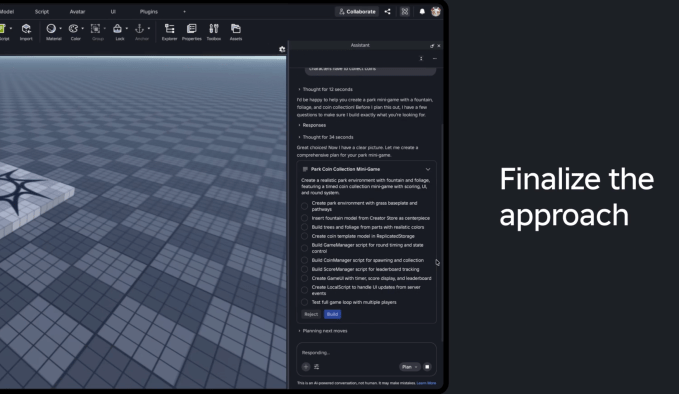
Traditional generative AI tools often fail to capture a developer’s specific vision when attempting to solve complex tasks in a single step. To overcome this limitation, Roblox is introducing “Planning Mode,” an enhanced workflow where the Assistant actively analyzes a game’s underlying codebase and data structure, asks clarifying questions, and generates editable action plans prior to writing code or making changes.
Through this conversational approach, creators can refine details, adjust parameters, and provide extra context before execution begins. Once the developer approves the plan, the Assistant executes the strategy across the project.
Image Credits:Roblox
For instance, if a user requests a “park mini-game with a fountain and foliage where characters have to collect coins,” the Assistant prompts the developer for artistic direction, offering stylistic options like cartoony, realistic, or fantasy. It also asks whether environmental assets should be constructed from scratch, sourced from the Roblox Creator Store, or built using a hybrid approach.
3D Generation Tools: Mesh and Procedural Modeling
Planning Mode integrates directly with Roblox’s growing suite of generative suite additions, including two newly launched features: Mesh Generation and Procedural Model Generation.
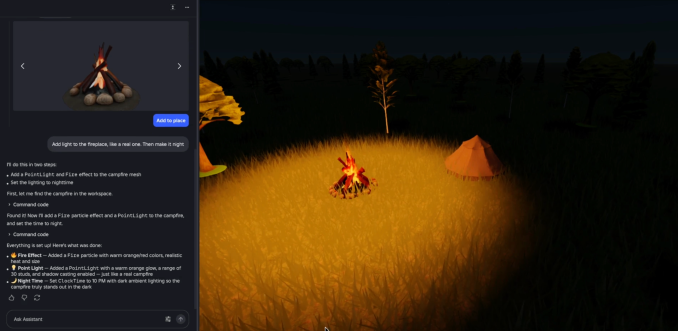
Mesh Generation allows developers to quickly generate fully textured 3D objects straight into their virtual environments. Instead of relying on grey-box blocks or low-quality placeholders during early production phases, creators can request detailed models instantly—such as generating a campfire, adding dynamic lighting for realism, and adjusting the environment to a nighttime setting with consecutive plain-language prompts.
Image Credits:Roblox
Additionally, Roblox is rolling out Procedural Models, which combine code execution with Assistant prompts to generate modifiable 3D objects. Because the AI factors in 3D physics and spatial relationships, creators can scale and place objects relative to surrounding assets. Key structural variables—such as adjusting the step count on a staircase or changing the shelf capacity of a bookcase—can be altered dynamically, providing reusable building blocks across the map.
“The launch of our agentic features in Roblox Studio reduces barriers between creative vision and execution,” stated Nick Tornow, Senior Vice President of Engineering at Roblox. “Creating with Planning Mode and our Procedural Generation tools is a powerful new method for creators to turn their concepts into gameplay. Assistant works as a multi-step, collaborative development partner — accelerating the process of planning, building, and testing, so creators can get from idea to reality faster.”
Autonomous Playtesting and Self-Debugging Loops
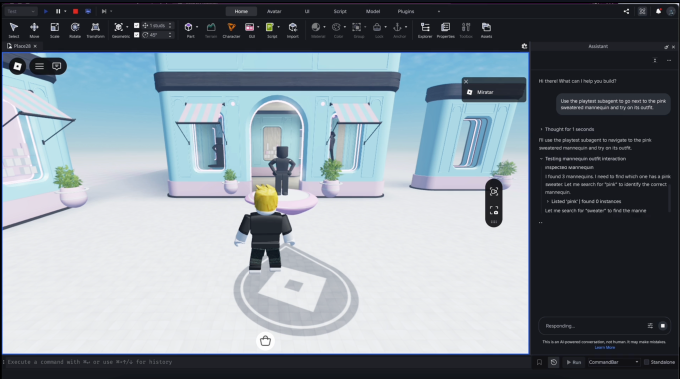
Beyond asset creation, Planning Mode operates within a self-correcting loop during the testing phase. The system initiates automated playtests, monitors output error logs, analyzes screen captures, and uses simulated keyboard and mouse inputs to evaluate game mechanics.
Image Credits:Roblox
When technical flaws or design bugs are detected, the system feeds diagnostics directly back into Assistant to apply automatic fixes. In a company blog post, Roblox highlighted that these agentic loops help suggest solutions and continuously refine game logic, creating an ecosystem that grows progressively more accurate over time.
Expanding Third-Party AI Tool Integrations
Looking ahead, Roblox plans to launch multi-agent orchestration, enabling several AI agents to execute complex development pipelines simultaneously in the cloud. These workflows will cover backend scripting, automated testing, and character rendering.
Roblox is also building native compatibility for external developer tools, confirming plans to integrate popular AI coding assistants like Claude, Cursor, and Codex directly into Roblox Studio.