

India’s lower house of parliament passed the sweeping Promotion and Regulation of Online Gaming Bill, 2025 on Wednesday in New Delhi to curb social harm and financial debt by imposing a nationwide blanket ban on all real-money online games.
The new legislation explicitly prohibits real-money games—whether reliant on skill or chance—and bans all associated financial transactions and advertisements across media platforms. While the bill aims to eliminate monetary wagering, it permits non-monetary casual gaming and esports to continue operating.
“In this bill, priority has been given to the welfare of society and to avoid a big evil that is creeping into society,” stated India’s IT Minister Ashwini Vaishnaw during the parliamentary session, citing reports of financial ruin and suicides linked to gaming losses.
Strict Penalties for Operators and Celebrities
Under the new law, financial institutions and banks are prohibited from processing any transactions related to real-money gaming in India. Operators offering these services face severe legal consequences, including up to three years in prison, a fine of up to ₹10 million (approximately $115,000), or both.
Promoters and high-profile figures endorsing these platforms will also face prosecution. Celebrities advertising real-money gaming products on any media platform can face up to two years of imprisonment or a fine of ₹5 million (roughly $57,000).
Industry Warning: A $23 Billion Market Under Siege
Ahead of the bill’s introduction, leading industry groups—including the Federation of Indian Fantasy Sports, the All India Gaming Federation, and the E-Gaming Federation—sent an urgent joint letter to Prime Minister Narendra Modi and Home Minister Amit Shah requesting immediate intervention. These organizations represent prominent domestic startups such as Dream Sports, Mobile Premier League (MPL), WinZO, Gameskraft, Nazara Technologies, and Zupee.
Industry estimates show that India’s real-money gaming sector holds an aggregate valuation of ₹2 trillion ($23 billion), generates ₹310 billion ($3.6 billion) in annual revenue, and contributes ₹200 billion ($2.29 billion) in direct and indirect taxes each year. Sector representatives warned that the ban puts more than 200,000 jobs at immediate risk and threatens the survival of over 400 companies.
“By shutting down regulated and responsible Indian platforms, it will drive [millions] of players into the hands of illegal matka networks, offshore gambling websites, and fly-by-night operators who operate without any safeguards, consumer protections, or taxation,” the industry letter cautioned.
Legal Challenges and Market Fallout
Legal experts argue that the legislation will face immediate constitutional challenges in court. Critics contend that the bill disproportionately targets legitimate domestic startups while failing to curb illicit foreign operations.
“This law is bound to face litigation as it fails the test of proportionality under Article 19(1)(g),” noted Meghna Bal, director of the New Delhi-based think tank Esya Centre, referencing the constitutional clause guaranteeing citizens the right to practice any trade or business. “Instead of safeguarding consumers, it dismantles compliant onshore companies while opening the door wider for illegal offshore betting platforms that are the real source of financial harm.”
Market reactions were immediate. Publicly listed gaming firm Nazara Technologies saw its share price plunge 12.84% on Wednesday, closing at ₹1,220 (about $14). Nazara clarified in a stock exchange filing that it maintains no direct exposure to real-money gaming businesses and derives no revenue from them.
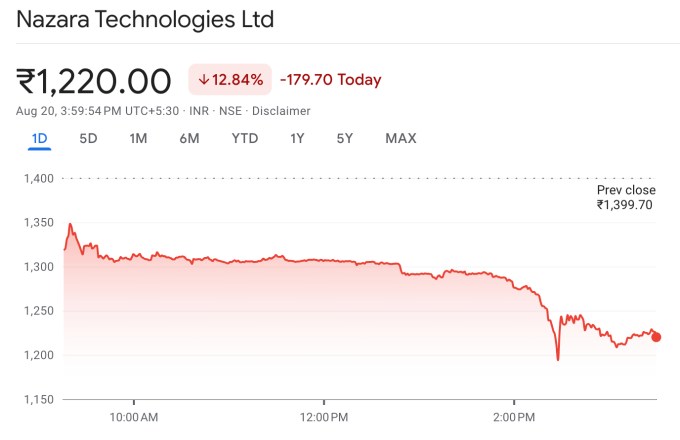
Top real-money gaming platforms including Dream Sports and MPL declined to issue official statements, while WinZO did not respond to requests for comment. Domestic and foreign investors are reportedly preparing coordinated strategic responses.
Rapid Legislative Passage and Ecosystem Split
The Lok Sabha passed the bill via a voice vote in less than seven minutes following its introduction amidst parliamentary commotion. To fully take effect as law, the bill requires approval from the upper house (Rajya Sabha) and assent from the President of India.
The legislative move created a clear divide within the broader gaming landscape. Hyper-casual and esports developers expressed optimism regarding the policy shift.
“We applaud this decision as it allows us to focus on the ongoing concerns as a business — monetization, retention, and most importantly, building great IP for India and the world, rather than having to explain to our audiences what we are to begin with,” said Sumit Batheja, CEO and co-founder of Ginger Games, an incubator participant under Krafton, the publisher behind PUBG.
I welcome the Govt’s decision to prohibit Real Money Gaming & establish a strong regulatory framework. 🇮🇳
Too many young lives were being lost to addiction & debt.
This decisive step safeguards our youth while unlocking the future of Indian gaming — driven by original IP,…
— Vishal Gondal (@vishalgondal) August 20, 2025
However, industry executives warn of regulatory spillover. Akshat Rathee, co-founder and managing director of NODWIN Gaming, emphasized that precise statutory boundaries must separate competitive esports from money-based gaming.
“The absence of precise definitions has often led to ambiguity and conflation around the term ‘esports.’ Such overlaps can create confusion not just for regulators, but also for players, teams, investors, and organizers who are working hard to build this industry,” Rathee explained.
Bal added that the bill could harm the wider Animation, Visual Effects, Gaming, and Comics (AVGC) sector, as a proposed government-appointed authority will dictate the legitimacy of esports operations.
Escalating Taxes and Regulatory Instability
This legislative action follows years of friction between Indian regulators and digital gaming companies. In 2023, the government amended the IT Rules to curb user harm and suggested self-regulatory frameworks, but internal dispute among market participants derailed implementation.
Concurrently, New Delhi imposed a heavy 28% Goods and Services Tax (GST) on online gaming in 2023. Major investment firms—including Tiger Global, Peak XV Partners, and Kotak—appealed directly to the government, warning of $2.5 billion in potential write-offs and massive job losses. Despite ongoing challenges in the Supreme Court over retrospective tax levies, recent policy discussions indicate the tax rate could rise further to 40%.
Policy analysts emphasize that sudden structural shifts create broader economic risk beyond the gaming sector.
“Regulation is necessary, but abrupt moves like this undermine India’s reputation as a stable, predictable investment destination. If concerns existed, the government should have signaled them clearly from the outset,” said Rohit Kumar, founding partner at public policy firm The Quantum Hub.












Leave a Reply