
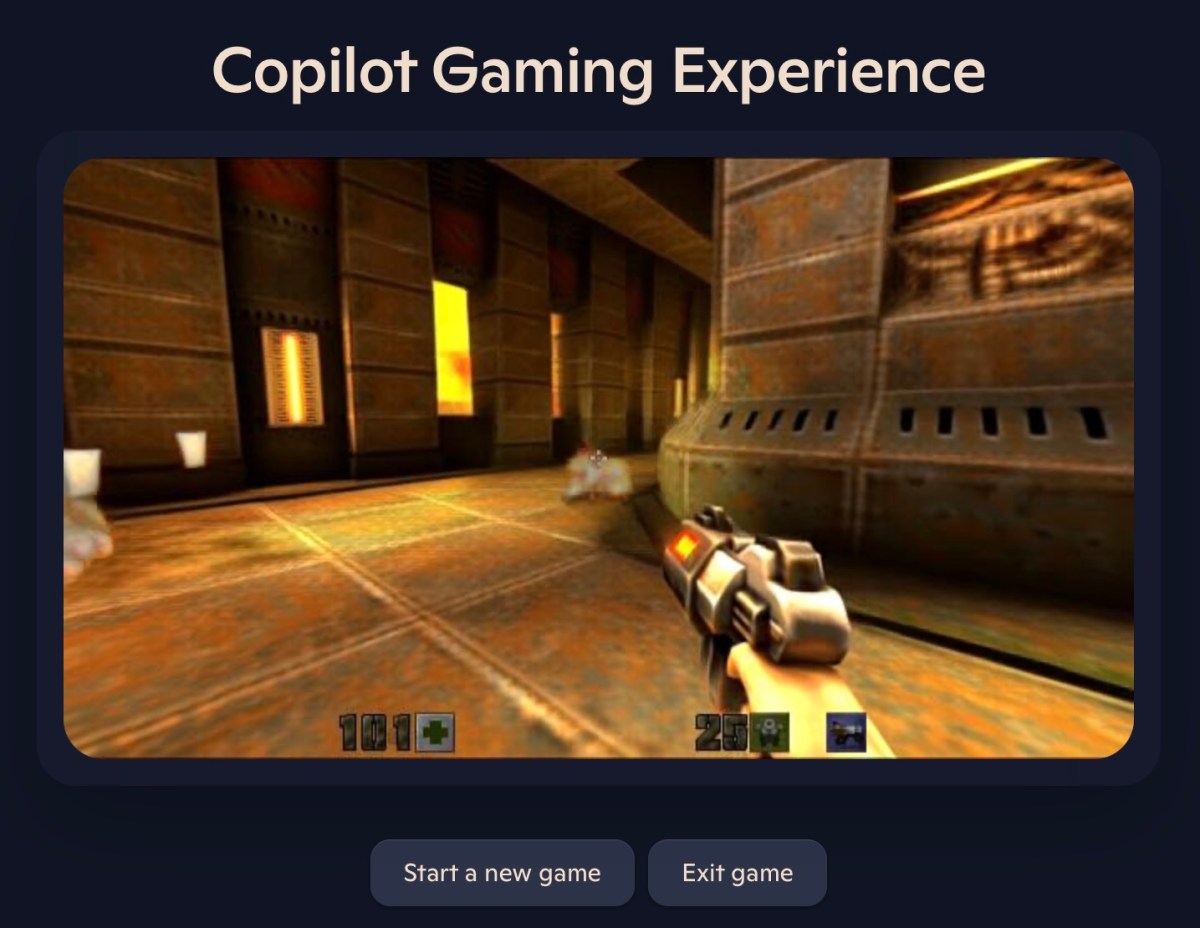
Microsoft researchers have released a browser-based, AI-generated tech demo of the classic shooter Quake II on the Copilot platform to showcase real-time world modeling, even as the company openly acknowledges severe visual and operational limitations.
Users can currently test the experimental demo online using standard keyboard controls to navigate a single level for a brief, timed session.
Simulating Quake II Inside an AI Model
According to a technical blog post published by Microsoft, the project utilizes the company’s Muse family of AI models designed specifically for interactive video game environments. The system processes player keyboard and controller inputs instantaneously, allowing users to interact directly within the generated simulation rather than executing pre-rendered game code.
To demonstrate the model’s predictive capabilities, developers trained the system using assets from Quake II, an IP Microsoft controls through its acquisition of ZeniMax Media.
“Much to our initial delight we were able to play inside the world that the model was simulating,” the research team stated. “We could wander around, move the camera, jump, crouch, shoot, and even blow-up barrels similar to the original game.”
Object Permanence and Glaring AI Limitations
Despite the technical milestone, the research team emphasized that the experience represents “playing the model as opposed to playing the game.” The demo suffers from severe technical drawbacks that depart significantly from traditional game rendering.
Key issues identified by the researchers include fuzzy enemy graphics, unreliable health and damage trackers, and critical failures in object permanence. Specifically, the neural network frequently forgets environmental elements and objects if they remain outside the player’s field of view for longer than 0.9 seconds.
Rather than framing this solely as a defect, researchers suggested the memory failure creates unintended mechanics: “This can also be a source of fun, whereby you can defeat or spawn enemies by looking at the floor for a second and then looking back up, or even teleport around the map by looking up at the sky and then back down.”
Industry Backlash and the Game Preservation Debate
The experimental demo has drawn sharp criticism from industry veterans. Game designer and writer Austin Walker shared a video demonstrating his session, during which he spent the majority of the time trapped inside an unrendered dark room—a failure mode reported by multiple testers.
Rebutting AI’s Role in Classic Game Porting
The tech demo arrives shortly after Microsoft Gaming CEO Phil Spencer suggested that generative AI models could assist in software preservation by making legacy titles instantly portable across modern hardware platforms.
Walker pushed back against Spencer’s assertion, arguing that generative models fundamentally misinterpret game architecture.
“The internal workings of games like Quake — code, design, 3d art, audio — produce specific cases of play, including surprising edge cases,” Walker noted. “That is a big part of what makes games good. If you aren’t actually able to rebuild the key inner workings, then you lose access to those unpredictable edge cases.”








Leave a Reply